Species Guides
Smallmouth Bass: Where to Find Them and What They Bite
Learn how to catch smallmouth bass — where they hold in rivers and lakes, the best baits by season, and how they differ from largemouth.
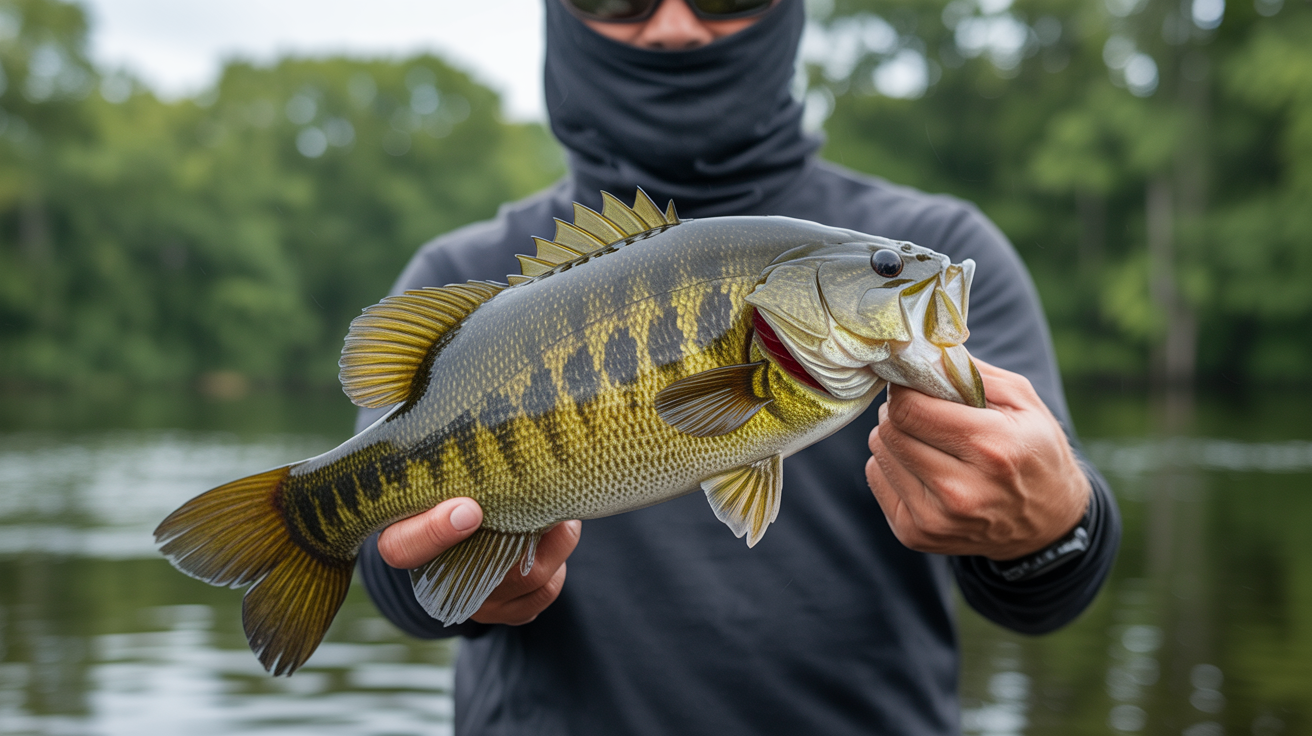
Smallmouth bass are one of the most satisfying freshwater fish to target. They hit hard, fight harder, and live in places that reward anglers who can read moving water and rocky structure. The catch: they're picky about habitat, and what works for largemouth often fails here. This guide covers where smallmouth hold across seasons, which baits trigger strikes, and how river fishing differs from lake fishing.
Always check your state or provincial fish and wildlife agency for current regulations, size limits, and open seasons before heading out, smallmouth rules vary widely by water body.
At a Glance
- Smallmouth key on hard bottom, rock, and gravel, not weeds. Rocky points, riprap, boulders, and river current seams are your starting points.
- They prefer cooler water than largemouth (roughly 60 to 72°F) and are more sensitive to water quality, finding good numbers is often a sign of a healthy water body.
- Crayfish are the primary forage almost everywhere. Any presentation that mimics a crayfish crawling the bottom, tubes, Ned rigs, craws, will produce.
- Tube jigs and the Ned rig are the two most consistent soft-plastic setups; jerkbaits are the top reaction-bait option in 50 to 68°F water.
- River fish hold in predictable current-relief spots: behind boulders, along seams, in gravel runs below riffles, and on outside bends.
- Seasonal depth shifts are large, spring fish sit in 4 to 10 feet, summer fish push to 12 to 25 feet or shaded pools, so match your depth to the calendar.
Smallmouth vs. Largemouth: Why the Difference Matters
These two species share a family tree but they don't share a habitat preference, and that shapes everything about how you fish for them.
Largemouth bass gravitate toward warm, weedy, slower water, lily pads, submerged vegetation, mud flats. Smallmouth prefer the opposite: cooler temperatures (ideally 60 to 72°F), hard bottom, and current or wave action. In a reservoir, smallmouth stack on rocky points, riprap banks, and gravel flats. In a river, they hold behind boulders, along current seams, and in gravel runs below riffles. Michigan's Department of Natural Resources sums up the split cleanly: largemouth are more often associated with shallow, weedier water or reservoirs with standing timber, while smallmouth are more closely linked to rocky habitat and rivers, even though both species can turn up in the same lake, according to the Michigan DNR's smallmouth bass species page.
There's a visual cue too. Largemouth have a jaw that extends past the rear edge of the eye. Smallmouth jaw stops short of it, and they show bronze-to-olive flanks with vertical dark bars rather than a lateral stripe.
Because they favor cleaner, harder substrate, smallmouth are also more sensitive to water quality. Finding them in good numbers is often a sign you're on a healthy body of water, and it means presentations that move slowly along the bottom through rocks and gravel are far more productive than power-fishing through cover.
For a comparison of largemouth tactics and gear, see our beginner's guide to largemouth bass.
Where Smallmouth Hold: Reading Structure in Lakes and Rivers
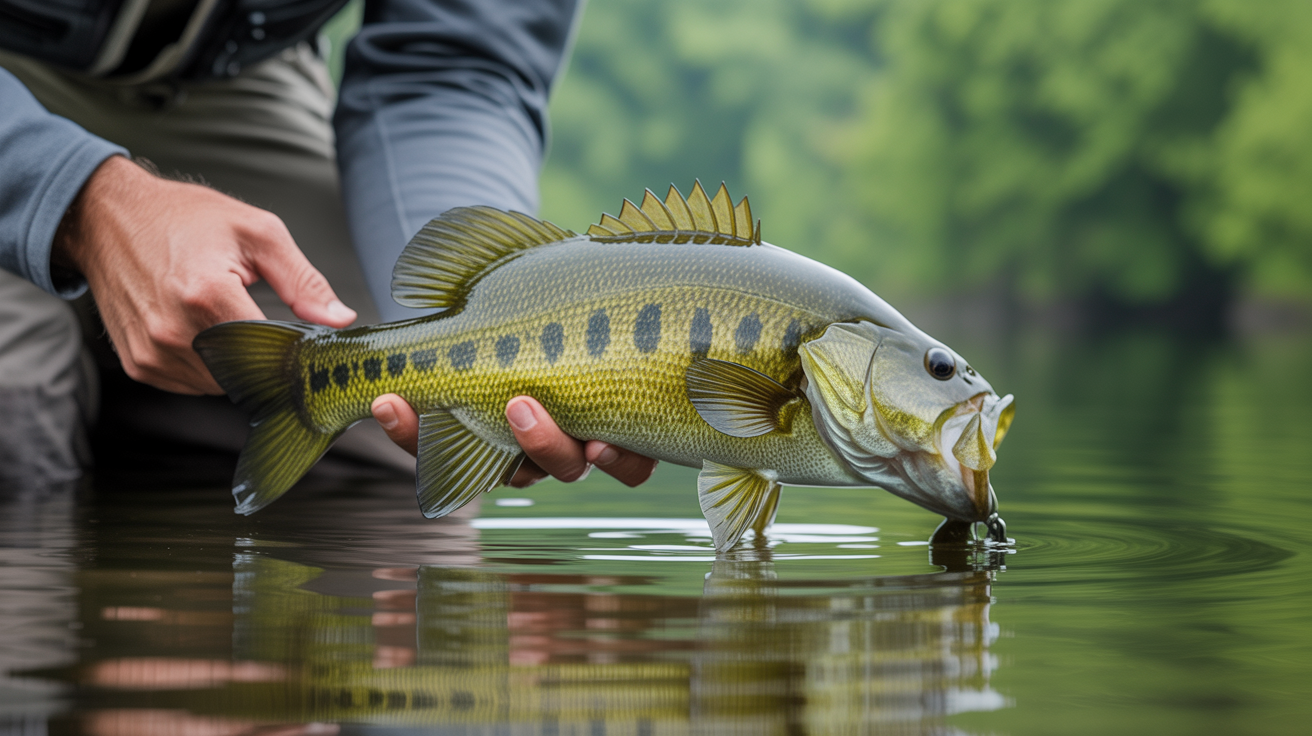
Rocky Lakes and Reservoirs
In still water, smallmouth key on hard-bottom structure almost exclusively. The Washington Department of Fish and Wildlife notes that smallmouth congregate in areas of large, rocky substrate, especially in deeper water during summer, and that crayfish are their favorite food, a pattern that holds true across most of their range, not just the Pacific Northwest.
Rocky points that extend out from shore are reliable year-round. The tip of the point matters most in summer; the shallower, sloping face of the point is better in spring as fish move up to spawn.
Gravel flats in 6 to 12 feet of water hold spawning fish in late spring. Smallmouth build nests in gravel, and once fry hatch they stay near the bottom for several days before working their way up and dispersing as a dark, dense cloud, guarded by the male the entire time. After the spawn, fish slide to deeper transitions, the break where a gravel shelf drops off into 15 to 25 feet. Riprap banks (the rock armoring along dam faces, causeways, and bridge abutments) hold fish because crayfish live in the crevices. Work the base of the rocks rather than the surface.
Boulders scattered across a flat are easy to overlook but often hold individual fish. Each large rock creates a subtle current break from wave action and provides shade and forage. A fish behind one rock is a reason to slow down and pick apart every boulder in the area. A useful habit: after boating a fish off one isolated boulder, mark it and come back to it later in the day. Smallmouth reoccupy productive individual rocks for weeks at a time.
Rivers and Streams
Current reading is the core skill for river smallmouth. Fish almost never fight the main current, they sit just outside it, expending minimal energy while food drifts to them.
Key spots to target:
- Behind boulders and large rocks, the eddy downstream of a submerged rock is a classic holding zone.
- Current seams, the line where fast water meets slower water. Cast into the fast side and let your bait swing across the seam.
- Gravel runs below riffles, riffles aerate the water and dislodge crayfish. Smallmouth stage just below in the run, picking off the easy meal.
- Outside bends, current carves deeper holes on the outside of a bend, and those holes hold fish in summer heat.
- Submerged logs and bridge pilings, any hard object breaking current holds fish, especially if there's depth nearby.
Water level affects everything in rivers. After rain raises and discolors the water, smallmouth often move to the shallower edges where current is slower. During low, clear-water conditions in late summer, fish push into the deepest available holes and become tougher to coax.
Best Baits for Smallmouth Bass
Soft Plastics: Tubes and Ned Rigs
Tube jigs are a traditional smallmouth staple for good reason. A 3 to 4 inch tube on a 3/16 to 3/8 oz internal jig head mimics a crayfish or a goby when dragged along the bottom. The multiple tail strands flutter even when the bait is sitting still, and the compact profile is right for the clear water smallmouth prefer. Use 6 to 8 lb fluorocarbon as your main line, it sinks, it's nearly invisible, and it resists abrasion on rocks.
The Ned rig (a small mushroom jig head with a 2.5 to 3 inch finesse worm or chunk, fished on light line) excels in clear, pressured water. The buoyant tail stands up off the bottom on the pause, creating a crayfish-like posture that smallmouth find hard to ignore. Fish it on a 6 lb fluorocarbon leader tied to 10 lb braid, using a light spinning rod with a fast action tip. See our Ned rig setup guide for rigging details.
Jerkbaits
A hard-bodied jerkbait (suspending, 4 to 5 inches) is the most effective reaction bait for smallmouth in 50 to 68°F water. The cadence is jerk-jerk-pause. How long you pause determines everything, in cold water, hold the pause for 3 to 5 seconds; in warmer conditions, one second is enough. Smallmouth frequently hit on the pause as the bait hangs motionless. Use 8 to 10 lb fluorocarbon and a medium-light rod with enough tip sensitivity to detect the tap.
Crayfish Imitations
Crayfish are the primary forage for smallmouth in most waters, confirmed by both state fisheries agencies and decades of stomach-content studies. Any presentation that mimics a crayfish moving along the bottom will produce, tube jigs, creature baits, small crankbaits that run 3 to 6 feet down. Crawl them slowly across gravel and rocks. When a smallmouth intercepts a crayfish, it pins it to the bottom before eating it, which is why slow retrieves outperform fast ones. A common mistake anglers make is bouncing a crankbait too fast through rocky structure, at that speed it looks nothing like a fleeing crayfish, which moves in short, panicked bursts followed by long stillness.
Live Bait: Crayfish and Minnows
Live crayfish (2 to 3 inches) on a light wire hook (size 1 or 1/0), hooked through the tail, rigged on 6 to 8 lb fluorocarbon with just enough split shot to get it to the bottom, is as effective as anything you can throw at smallmouth in a river. The challenge is keeping them alive in a bait bucket with an aerator and keeping the water temperature from rising. In rivers, drift the crayfish along the bottom through current seams.
Live creek minnows or shiners (2 to 4 inches) fished under a slip float work well in lakes, especially in late fall when smallmouth are feeding aggressively before turnover. Set the float so the minnow hangs 1 to 2 feet off the bottom. Let it drift over rocky points and along the base of riprap.
Seasonal Patterns at a Glance
| Season | Water Temp | Where Fish Hold | Best Presentations |
|---|---|---|---|
| Spring (pre-spawn) | 48–58°F | Shallow gravel flats, rocky banks, 4–10 ft | Jerkbaits, tube jigs, slow-rolled swimbaits |
| Spawn | 58–65°F | Gravel beds in 2–8 ft, protected coves | Stand-off or observe; post-spawn fish are aggressive |
| Summer | 68–78°F | Deep rock transitions, 12–25 ft; shaded river pools | Drop shot, Ned rig, tubes on bottom |
| Fall | 55–65°F | Rocky points, feeding up before cold; river tailouts | Jerkbaits, live minnows, fast-moving crankbaits |
| Late fall / early winter | Below 55°F | Deep, slow holes; minimal movement | Ned rig, tube dead-sticked on bottom |
One note on spawning fish: many anglers choose not to target fish actively on beds during the spawn to avoid disrupting the nest. Regulations in some states restrict it. Check local rules, and consider the fish's situation before targeting them in shallow spawning areas.
River Tactics vs. Lake Tactics: A Quick Comparison
River and lake smallmouth are the same species behaving very differently. This side-by-side covers the practical differences that actually change how you fish.
| Factor | River Smallmouth | Lake Smallmouth |
|---|---|---|
| Primary structure | Current seams, boulders, riffles | Rocky points, gravel flats, riprap |
| Casting direction | Upstream, let it drift down naturally | Parallel to structure for a longer strike window |
| Depth driver | Current speed and holding lie | Thermocline and light penetration |
| Typical gear | 6'6"–7' medium-light spinning, 10 lb braid + 6–8 lb fluoro leader | Similar rod, often paired with a fish finder for depth |
| Low-water adjustment | Downsize to 1/8 oz Ned head, 6 lb fluoro, shorter casts | Slide deeper along the same structure |
| Best low-light window | Dawn and dusk, though current keeps fish feeding midday too | Early morning shallow push, deeper by midday |
Fishing Rivers
Position is everything. Wade fishing or anchoring upstream of a target and casting downstream gives you a natural presentation, your bait drifts with the current the way a crayfish would. Casting upstream and retrieving faster than the current works too, but the downstream drift is often more convincing.
Spinning gear handles river smallmouth well. A medium-light 6'6" to 7' rod with a 2500-series spinning reel loaded with 10 lb braid and a 6 to 8 lb fluorocarbon leader gives you casting accuracy with light jigs and enough backbone to move a fish away from rocks.
In fast, rocky rivers, use a 3/8 oz tungsten jig head instead of lead, it stays in contact with the bottom better through current and the added sensitivity of tungsten tells you what kind of bottom you're dragging over.
When the water is low and clear (common in late summer), downsize everything. Go to a 1/8 oz Ned head, 6 lb straight fluorocarbon, and shorter casts. River fish in low water are skittish; a heavy splash or a line slapping the water sends them to the bottom of the hole.
Fishing Lakes
In a lake or reservoir without current, depth transitions drive everything. Use a trail map or a simple fish finder to locate the drop from a gravel flat into deeper water. Smallmouth hover at the top of that transition in morning and evening, sliding deeper as light increases.
Long casts parallel to structure often outperform casts directly at it, especially in clear water. If you're wading or kayak fishing a rocky point, cast parallel to the bank so your bait stays in the strike zone longer rather than swinging through it quickly.
For trout-water lakes that also hold smallmouth, presentation finesse matters even more, these are often clear, cold bodies of water where fish see a lot of pressure. Light line and small finesse presentations outperform big baits consistently. See our trout lake fishing guide for more on reading clear, cold water.
FAQ
What line weight is best for smallmouth bass?
For most smallmouth situations, 6 to 10 lb fluorocarbon as a main line or leader covers the range. In rivers with rocks and current where a break-off is costly, 10 lb is a reasonable floor. For finesse tactics in clear lake water, 6 to 8 lb fluorocarbon gives you better presentation. If you're fishing braid-to-leader, 10 to 15 lb braid with a 6 to 8 lb fluoro leader is a versatile setup for spinning tackle.
Do smallmouth bass and largemouth bass ever live in the same water?
Yes, particularly in large reservoirs that have both rocky and weedy areas. You might catch largemouth in a weedy backwater cove and smallmouth on the rocky point 200 yards away on the same afternoon. In rivers, largemouth are less common but will appear in warmer, slower backwater sections while smallmouth dominate the faster, rockier main channel.
What's the best time of day to fish for smallmouth?
Early morning and late evening are the most consistent windows in summer, when fish are more active in the shallows. On overcast days, that window extends through most of the morning. In rivers, low-light periods are still good but smallmouth will feed through the day if current and temperatures are favorable. On bright, hot summer afternoons, fish are in the deepest available structure and harder to reach from shore.
Do I need a boat to catch smallmouth bass?
No. Many productive smallmouth rivers and rocky lake shorelines are wade-fishable or accessible from the bank. A kayak opens up more water, especially in rivers, but it's not required. Some of the most consistent shore fishing for smallmouth is along riprap banks, rocky points accessible by foot, and river wading spots. If you're bank fishing a lake, crappie fishing spots and smallmouth spots often overlap around dock pilings and rocky structure.
Are smallmouth bass good to eat?
They're a fine table fish with firm white meat, similar to largemouth. Whether you keep them is a personal and regulatory decision. Many smallmouth rivers have slot limits (keeping fish between a certain size) or size minimums, check current regulations for your specific water body before keeping any fish.
How big does a smallmouth bass typically get?
Most smallmouth caught by anglers run 8 to 15 inches and weigh under 3 pounds, though fish in waters with strong forage and habitat can reach 5 to 6 pounds or more. They mature around age three or four and can live 10 to 12 years, so a healthy population depends on protecting a range of size and age classes, not just the biggest fish.
Why can't I find smallmouth in the same spots I catch largemouth?
Because they're keying on different features of the same water body. Largemouth sit tight to weeds, wood, and shallow cover regardless of bottom type. Smallmouth ignore soft, mucky bottom almost entirely and instead relate to hard structure, rock, gravel, and current. If you're marking bass on a fish finder over a mud flat, they're almost certainly largemouth. Move to the nearest rocky point or riprap bank to find smallmouth in the same lake.
Tackle Theory is an independent freshwater-fishing resource. Our guides are researched and written in-house; we are not affiliated with, endorsed by, or sponsored by any tackle brand, guide service, or retailer mentioned here. Fishing licenses, seasons, and size and creel limits vary by location and change often, always confirm current regulations with your local fish and wildlife agency.