Gear & Tackle
Fishing Line Explained: Mono vs. Braid vs. Fluorocarbon
Learn the real differences between monofilament, braided, and fluorocarbon fishing line so you can spool the right line for freshwater beginners.
Walk into any tackle shop and you'll find an entire wall of line. Three main types dominate freshwater fishing: monofilament, braid, and fluorocarbon. Each behaves differently in the water, ties knots differently, and suits different situations. Knowing which to spool, and why, will make you a more effective angler from the first cast.
Here's the short answer before the details: monofilament is the best starting line for most beginners. It's affordable, forgiving, and works well across a wide range of situations. The rest of this guide explains what makes each type tick, so you can add braid and fluorocarbon to your arsenal when the time is right.
What Monofilament Is and When to Use It
Monofilament ("mono") is a single extruded strand of nylon. It's been the default fishing line for decades, and for good reason.
Key properties
Stretch: Mono stretches roughly 15–30% before breaking. That built-in shock absorption acts as a buffer when a fish makes a sudden run, reduces the chance of a hook tearing free on the hookset, and forgives mistakes, like a slightly loose drag or a slow reaction time. For beginners, this stretch is an asset, not a flaw.
Visibility: Nylon is relatively visible underwater. Most mono comes in clear or green tints, which blend reasonably well, but it's still more visible than fluorocarbon. In heavily pressured, clear-water fisheries this can matter. In stained water or when targeting less wary species like bluegill or catfish, it's a non-issue.
Buoyancy: Mono is nearly neutrally buoyant and tends to float or suspend just below the surface. This makes it a natural pairing for topwater lures and bobber rigs, where you want the line to sit up in the water column.
Knot strength and ease: Mono is soft and supple. It ties easily into every common knot, the improved clinch, Palomar, uni, and the knots hold well. This is a real advantage when you're still learning to tie.
Abrasion resistance: Standard mono handles bumping rocks and timber reasonably well, though it's not as tough as braid. It also degrades with UV exposure over time, so replace it every season or two.
Cost: Mono is the cheapest option by a significant margin. A large spool costs very little and fills reels generously.
Best freshwater uses for mono
- Bobber/float rigs for panfish, crappie, and bass
- Topwater lures (poppers, buzzbaits) where floating line is an advantage
- Spinning setups for beginners learning to cast
- Situations with sharp hooks and fast hooksets where some stretch prevents tearing
What Braided Line Is and When to Use It
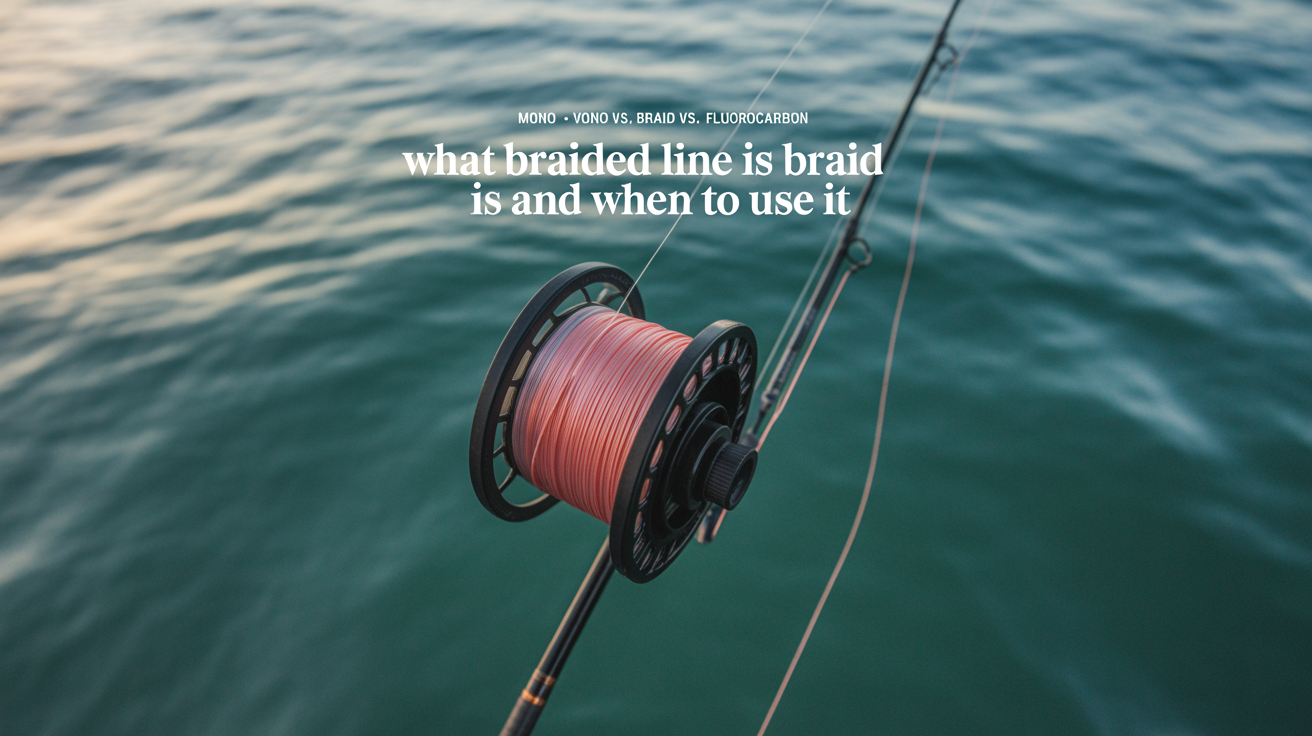
Braid is woven from multiple strands of ultra-high-molecular-weight polyethylene (UHMWPE) fibers, often sold under trade names like Dyneema or Spectra. It looks and feels fundamentally different from mono.
Key properties
Stretch: Braid has virtually no stretch, typically less than 3%. Every bump on the bottom, every nibble, travels straight up to your hands. This sensitivity is braid's defining advantage. You'll feel strikes you'd completely miss on mono.
Diameter: Pound for pound, braid is dramatically thinner than mono. A 30 lb braid can have the diameter of 8 lb mono. That thin profile cuts through water for deeper presentations and lets you fit far more line on a reel spool.
Strength: Braid is very strong for its diameter and holds up well to abrasion against heavy cover like rocks, dock pilings, and dense weeds.
Visibility: This is braid's biggest drawback. It comes in high-visibility colors (yellow, green, white) that are easy to see above water but also highly visible to fish in clear conditions. Unlike fluoro, it doesn't refract light the way water does, it stands out.
Floating: Braid floats, which is good for topwater but means it can catch surface tension on windy days.
Knots: Braid is slippery and hard. Standard knots tied in mono will slip on braid. The Palomar knot works reliably, as does a modified uni-to-uni connection when attaching a leader. Always wet the knot before cinching.
Cost: Per yard, braid costs more than mono upfront, but it lasts years without breaking down from UV or water, so the long-term cost is reasonable.
Best freshwater uses for braid
- Heavy cover fishing (flipping into thick weeds or brush piles)
- Jigging and bottom fishing where sensitivity matters
- Deep cranking where stretch would dull the feel
- As a main line when paired with a fluorocarbon leader (more on that below)
What Fluorocarbon Is and When to Use It
Fluorocarbon is made from polyvinylidene fluoride (PVDF). At first glance it looks like mono, but its optical and physical properties are quite different.
Key properties
Visibility: Fluorocarbon has a refractive index very close to water (about 1.42, versus water's 1.33). That means light passes through it with minimal bending, making it nearly invisible underwater. This is the main reason anglers choose fluoro, in clear water, pressured fish, or when targeting species like trout that are sensitive to line, fluoro gives you a genuine edge.
Stretch: Fluoro stretches less than mono (roughly 6–10%) but more than braid. The hookset is sharper than with mono, and you have a bit more sensitivity. However, fluoro is stiffer than mono, which can cause issues with coiling and line memory on spinning reels.
Density: Fluoro is denser than water and sinks. This makes it ideal for bottom presentations, drop shots, Carolina rigs, and jigs where you want the line to pull down toward the bottom.
Abrasion resistance: Fluoro is tougher than mono against rocks and gravel, a meaningful advantage when fishing structure.
UV resistance: Unlike mono, fluoro doesn't degrade from sunlight. A spool lasts much longer.
Knots: Fluoro is stiffer and less forgiving in knots than mono. The improved clinch works, but you'll want to use enough wraps (at least 5–6) and always wet the knot before pulling tight. Loose or dry knots in fluoro fail more often than in mono.
Cost: Fluoro is the most expensive of the three, often 3–4 times the cost of mono per yard.
Best freshwater uses for fluoro
- Clear-water fishing for wary species (trout, smallmouth bass in rivers)
- As a leader material attached to braid
- Bottom rigs: drop shots, Carolina rigs, finesse jigs
- Crankbaits fished near rocky structure (toughness + sensitivity)
The Braid-and-Fluoro-Leader Setup
Many experienced anglers spool braid as their main line and attach 12–24 inches of fluorocarbon as a leader. The setup gives you the best of both:
- Braid's thin diameter fills the spool efficiently and provides sensitivity throughout the retrieve
- Fluoro's near-invisibility at the business end means the fish sees no line near the lure or bait
To connect them, use a double uni knot or an Alberto knot. These leader-to-main-line connections pass through the rod guides smoothly and hold reliably. Once you're comfortable on a spinning reel and have learned to manage braid (see our guide on how to spool a spinning reel without line twist), this is a versatile setup worth trying.
Line Comparison Table
| Property | Monofilament | Braid | Fluorocarbon |
|---|---|---|---|
| Stretch | High (15–30%) | Minimal (under 3%) | Low (6–10%) |
| Visibility underwater | Moderate | High | Very low |
| Floats or sinks | Floats/suspends | Floats | Sinks |
| Abrasion resistance | Moderate | High | High |
| Knot ease | Easy | Moderate (slippery) | Moderate (stiff) |
| UV durability | Low (replace yearly) | High | High |
| Cost | Low | Medium–high | High |
| Best beginner use | General all-around | Heavy cover, sensitivity | Leaders, clear water |
What Beginners Should Actually Spool
Start with 8–12 lb monofilament on a spinning reel. This covers nearly every freshwater scenario, bass, panfish, crappie, catfish, walleye, without asking you to manage the quirks of braid or fluoro while you're still learning casting, hook-setting, and knot-tying.
Once you're comfortable with the basics, the natural progression is:
- Add a fluoro leader to your mono main line when fishing clear water. You don't need to respool, just tie 18 inches of 8 lb fluoro to your existing line with a double uni knot.
- Spool braid on a second rod (or the same rod after you've fished it out) when fishing heavy cover or jigging deep water.
- Use fluoro as a full main-line spool on a dedicated rod for finesse fishing or trout in rivers.
There's no single "best" line. The right choice depends on where you're fishing, what species you're after, and what technique you're using. But mono gets you fishing fast, cheap, and with fewer headaches.
For more on building your setup from the ground up, check out our guides on how to choose a fishing rod and spinning reel vs. baitcaster, understanding rod action and reel type will help you match your line choice to your whole setup.
FAQ
Can I mix monofilament and fluorocarbon on the same reel?
Yes. Many anglers spool mono as a backing (to save money on expensive fluoro) and then top it off with fluorocarbon as the working portion of the spool. Use a double uni knot to connect them. Because fluoro is denser, it will lay over the mono cleanly.
Why does braid sometimes cut into itself on the spool?
Braid's thin, hard fibers can bury into lower layers under tension, especially if the reel is spooled too loosely or the line is thin relative to the spool. Fill the spool with firm, even tension, backing off the drag slightly and holding the line between your thumb and forefinger while reeling helps lay the braid evenly.
Is fluorocarbon worth the extra cost for beginners?
As a full spool, no, not until you've got casting and knot-tying dialed in. As a leader material, yes. A small spool of 8–10 lb fluorocarbon lasts a long time when you're only cutting off 18-inch sections, and the added stealth in clear water is real.
Do I need to change my line every season?
Monofilament breaks down from UV exposure and water absorption over time. Inspect it before each season by running it between your fingers, if it feels rough, brittle, or shows any kinking or flattening, replace it. Fluorocarbon and braid are far more durable and may last several seasons if stored out of direct sunlight.
Does line color matter for freshwater fishing?
For the main line, not much, fish see the line near the lure, not 30 feet up the spool. High-visibility colors on braid (yellow, orange) are actually useful because you can watch the line for subtle strikes before you feel them. Where color matters most is in the final few feet near the hook, which is exactly why fluoro leaders make sense in clear water.
Tackle Theory is an independent freshwater-fishing resource. Our guides are researched and written in-house; we are not affiliated with, endorsed by, or sponsored by any tackle brand or retailer. Fishing regulations vary by location, always confirm current rules with your local fish and wildlife agency before you head out.