Gear & Tackle
Fishing Hooks Explained: Sizes, Types, and When to Use Each
Learn fishing hook sizes, the # vs. /0 scale, hook anatomy, and which types suit panfish, bass, catfish, and more. Includes a size-by-species table.
Walk into any tackle shop and the hook rack can stop you cold. Hundreds of options, cryptic size numbers running in two directions, and names like "octopus" and "EWG" that give you no real hint of what they do. This guide cuts through that. By the end you'll know how the sizing system works, what the main hook styles do, and how to match a hook to the fish and bait you're actually using.
At a Glance
- Hook sizing runs in two directions: plain numbers (#14 to #1) get smaller as the number rises, aught sizes (1/0 to 12/0+) get larger.
- There's no "0" hook, the scale jumps straight from #1 to 1/0.
- Circle hooks roll into the corner of the mouth on their own, making them the standard choice for catch-and-release and unattended rods.
- Match the hook to the bait first: the point needs to clear the bait cleanly when you set it.
- A #6 or #4 baitholder covers most beginner panfish-to-bass situations with one hook style.
- Rinse, dry, and replace rusted hooks, dull or corroded points cost you more fish than most anglers realize.
How Hook Sizes Work
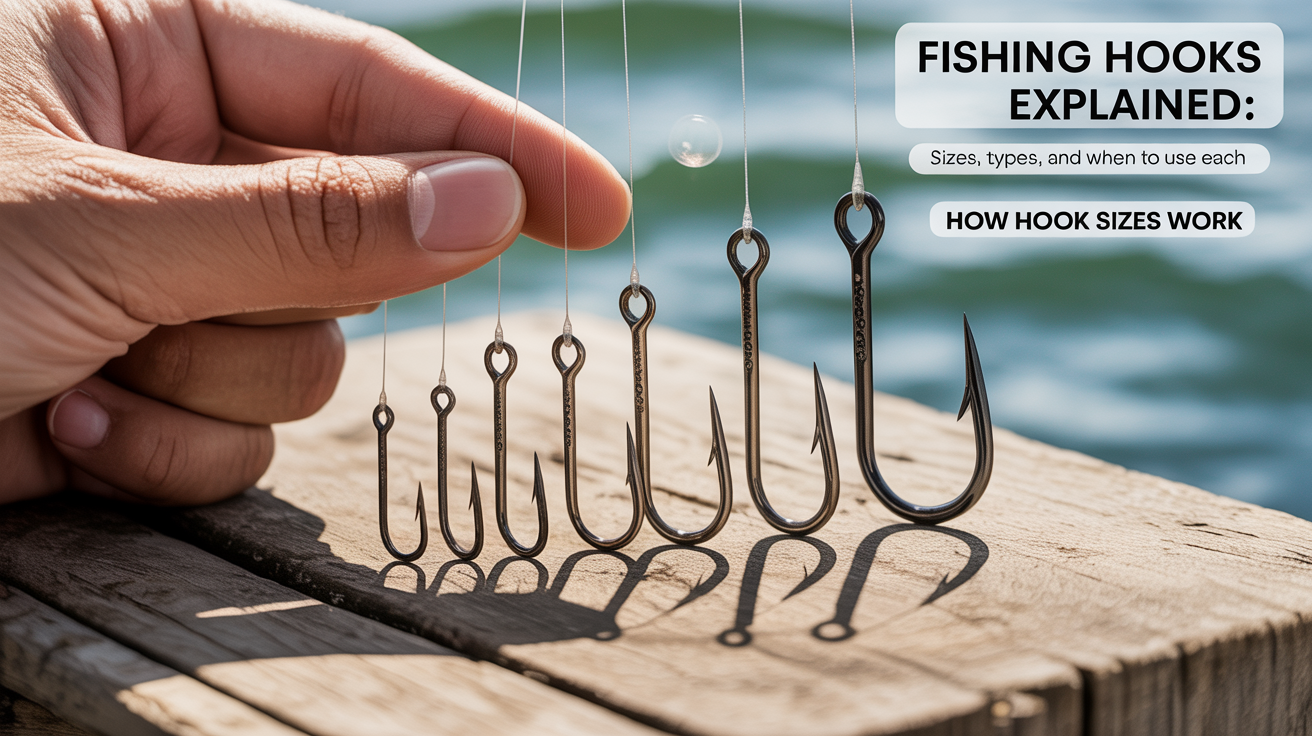
Hook sizing has a reputation for being confusing, and it earned it. The system runs in two separate directions depending on where you land on the scale. Take Me Fishing's guide to fishing hook sizes sums up the raw scale this way: hooks run "from 32 (the smallest size) to 1 and then 1/0 aughts to 19/0 aughts (the largest size)." Everything in this section explains what that actually means at the bench.
The # Scale (Smaller Hooks)
Hooks labeled with a plain number, #14, #10, #6, #2, get smaller as the number rises. A #14 is tiny, about right for a midge or a single maggot. A #2 is noticeably large, suitable for a chunky nightcrawler or a small sucker bait.
Think of it this way: the higher the number, the more cramped the gap. That trips up nearly every new angler at least once.
The /0 "Aught" Scale (Larger Hooks)
Once you cross into the "aught" range, 1/0, 2/0, 3/0, 4/0, and up, the logic flips. Now the number rises as the hook gets bigger. A 1/0 (said "one-aught") is just slightly bigger than a plain #1. A 4/0 is substantially larger.
Big-bait fishing, catfish rigs, and bass soft-plastics all live in this zone. Muskie and pike anglers work with hooks as large as 10/0 or 12/0, though those are saltwater-scale sizes rarely needed in freshwater.
The Gap in Between
There is no "0" hook, the scale jumps from #1 straight to 1/0. It's an arbitrary historical quirk worth remembering so you don't go hunting for a hook that doesn't exist.
Hook Anatomy: What the Parts Are Called
Knowing the vocabulary makes choosing and rigging hooks much easier. Take Me Fishing's guide to choosing fishing hooks breaks a hook down into the same six parts anglers have used for generations:
- Point, the sharp tip that penetrates. Fine points are sharper out of the box; chemically sharpened points hold their edge longer.
- Barb, the small back-facing spike just behind the point. It prevents a hooked fish from shaking free. Flattening the barb with pliers ("pinching the barb") makes hook removal easier and is required on many catch-and-release fisheries.
- Gap (or gape), the distance between the point and the shank. A wide gap hooks more of the fish's mouth; a narrow gap tracks through weeds more cleanly.
- Shank, the long straight section running from the bend to the eye. Long shanks make it easier to hook soft baits and to remove hooks from fish. Short shanks are less visible in small presentations.
- Eye, the loop at the top where you attach your line. Eyes come in straight (inline), turned-up, and turned-down orientations, and each affects how the hook lies in the water.
- Bend, the curved section connecting the shank to the point side of the hook.
Common Hook Types and What They're For
Bait/Baitholder Hook
The baitholder is the most generic hook in freshwater fishing. It has a medium-length shank, a standard J-shaped profile, and one or two small barbs cut into the shank to grip soft baits like nightcrawlers and PowerBait. If you're fishing a simple bobber-and-worm rig, this is the hook. Sizes #8 through #2 cover most panfish and perch work; move to 1/0–2/0 for catfish bait rigs.
Octopus Hook
Shorter shank, slightly swept-back point, and a turned-up or turned-down eye. The compact profile makes it good for live minnows, cut bait, and snell rigs for walleye. Because the hook doesn't project far behind the bait, it presents naturally. Sizes 1/0–3/0 are common for walleye and bass; #4–#6 for panfish and perch with small minnows.
Circle Hook
A circle hook has a dramatically inward-turned point, it curves back almost parallel to the shank. When a fish runs with the bait, the hook rolls out and catches in the corner of the mouth almost automatically. You don't need to strike aggressively; just reel down and let the fish load the rod. That corner-mouth hookup is much easier to remove than a swallowed hook, which is why circle hooks are standard for catch-and-release catfish, walleye, and bass fishing. Sizes 2/0–5/0 for catfish; 1/0–3/0 for bass.
J Hook (Standard)
The classic hook shape most people picture. You do need to set the hook yourself, a sharp upward or sideways sweep when you feel the bite. J hooks are fast to tie, versatile, and cheap, which is why they remain the default for most freshwater rigs. The trade-off is a higher rate of deep hooking compared to circles, especially when fish have a chance to swallow the bait.
Worm Hook / EWG (Extra Wide Gap)
Designed specifically for soft-plastic worms, creature baits, and swimbaits. The wide gap accommodates the bulk of the plastic while still exposing enough point to hook the fish when you set. The offset shank lets you rig the plastic weedless, Texas-style, with the point buried back in the body, so you can drag it through weeds and brush without snagging. Sizes 2/0–4/0 cover most bass soft-plastic work.
Aberdeen Hook
A thin-wire, long-shank hook originally used for panfish and light bait fishing. The wire is light enough that it bends when snagged on brush rather than snapping your line, a genuine advantage when you're fishing around laydowns for bluegill and crappie. The long shank makes de-hooking quick. Sizes #4–#10 are the most common.
Treble Hook
Three bends and three points sharing one eye. Trebles are pre-attached on most hard lures, crankbaits, spinnerbaits, jerkbaits, because they intercept strikes coming from any angle. They're not typically tied on directly for bait fishing (the multiple points tangle baits and are hard on fish during release). If you're replacing factory trebles on a lure, match the original size; going bigger throws off the lure's action.
Jig Hook
A bent-neck hook molded into a lead head. The bend in the shank angles the hook point upward when the jig is on bottom, which dramatically reduces snagging. Most jig heads come with the hook fixed in place. They're used for everything from crappie (1/16–1/4 oz heads with #2–1/0 hooks) to walleye and bass (1/4–3/4 oz with 3/0–5/0 hooks).
Circle Hook vs. J Hook: Which to Use
The choice usually comes down to what you're doing with the fish after you land it. See the fishing line guide for notes on how line choice interacts with hook performance, stiff fluorocarbon, for example, transfers strike energy differently than soft mono.
Use a circle hook when:
- You're releasing the fish and want corner-of-mouth hookups
- You're fishing unattended rods (common in catfish and carp fishing) and can't strike on time
- The fishery or regulations require them, some trout and salmon waters mandate circle or barbless hooks
Use a J hook when:
- You're actively watching the rod and can set the hook yourself
- You're fishing with lures or rigs that require an aggressive strike to seat the hook
- Speed matters and you want the simplest possible setup
One thing to avoid with circle hooks: the instinctive hard hookset. A fast upward sweep will pull the hook out of the fish's mouth before it can rotate into position. Reel tight and let the bend do the work.
Matching Hook Size to Bait and Species
The right hook is one that fits the bait cleanly and suits the size of the fish's mouth. A hook that's too small gets buried in a big piece of bait and never finds flesh. A hook that's too large on a light bait looks unnatural and can inhibit strikes.
| Target Species | Suggested Hook Size | Notes |
|---|---|---|
| Bluegill / Sunfish | #8 – #6 | Small baitholder or Aberdeen; nightcrawler pieces, wax worms |
| Crappie | #6 – #2, 1/0 | Aberdeen or octopus; small minnows or jig heads |
| Yellow Perch | #8 – #4 | Aberdeen or baitholder; minnows, small worms |
| Trout (stream) | #14 – #8 | Light-wire; worms, salmon eggs, small spinners |
| Trout (lake/reservoir) | #10 – #4 | Baitholder or egg hook; PowerBait, worms |
| Largemouth Bass (soft plastic) | 2/0 – 4/0 EWG | Weedless Texas rig; match to plastic body size |
| Largemouth Bass (live bait) | 1/0 – 3/0 | Octopus or circle; large shiners, crawfish |
| Smallmouth Bass | 1/0 – 2/0 | EWG or octopus; tubes, crawfish imitations |
| Walleye | #4 – 1/0 | Octopus or circle; leeches, nightcrawlers, minnows |
| Catfish (channel/blue) | 2/0 – 5/0 | Circle hook preferred; cut bait, chicken liver, nightcrawlers |
| Catfish (flathead) | 5/0 – 8/0 | Live bream or large suckers; strong wire |
| Northern Pike / Muskie | 3/0 – 6/0 | Heavy-gauge octopus or inline single; large sucker or shiner |
| Carp | 4 – 8 (carp/bait hooks) | Hair-rig style; corn, boilies, dough baits |
For rod and reel pairing once you have the right hook, the rod selection guide covers how rod power and action affect your ability to set the hook at various sizes. And if you're new to the casting and rod setup side, the spinning reel vs. baitcaster guide helps you pick the right reel before you worry too much about hooks.
A Worked Example: Bass Soft Plastic to Live Bait
If you're rigging the same 5-inch stick worm two ways, the hook choice changes the math. Texas-rigged weedless through cover, you want a 3/0–4/0 EWG worm hook, wide enough gap to clear the bulk of the plastic when you set, offset shank to bury the point flush. Fished the same worm wacky-style (no weight, hooked through the middle) in open water, you'd drop to a 1/0–2/0 wide-gap hook instead, since there's no plastic bulk to clear and a smaller hook moves more naturally. Same bait, same fish, two different hooks depending on how you're presenting it, that's the kind of decision this size-by-species table is meant to shortcut.
Wire Gauge: Why Hooks of the Same Size Aren't Always the Same Hook
Two hooks can share the same number and still behave completely differently on the water, because size only describes gap and shank length, not wire thickness. Wire gauge is the piece beginners tend to skip past, and it changes how a hook performs almost as much as size does.
Thin-wire hooks, like the Aberdeen style covered above, penetrate easily with light pressure and are the right choice on light line, since a heavy hook on 4-pound test can be nearly impossible to drive home. The trade-off is that thin wire bends or straightens under heavy pressure, which is exactly the behavior that makes Aberdeens forgiving around brush but risky on a genuinely big fish.
Heavy-wire hooks need more force to set but hold their shape under sustained pressure, dragging a flathead catfish out of submerged timber, for instance, or horsing a big bass through matted vegetation. Pairing wire gauge to line strength is the practical rule: light wire with light line, heavy wire with heavy line. A heavy-wire 2/0 on 6-pound trout line will rarely penetrate a soft mouth; a light-wire 2/0 on 40-pound catfish braid will straighten out on the first serious run.
| Line Strength | Suggested Wire Gauge | Typical Use |
|---|---|---|
| 2–8 lb | Light wire (fine wire, Aberdeen-style) | Panfish, trout, light bait rigs |
| 8–17 lb | Standard/medium wire | Bass, walleye, most general freshwater work |
| 20 lb+ | Heavy wire (forged, extra-strong) | Catfish, pike, muskie, heavy cover flipping |
Sharpness, Care, and Safety
A hook that can't stick to your thumbnail easily needs replacing or touching up with a hook file. Hooks dull faster than most anglers expect, especially after contact with rocks, gravel bottom, or a fish's bony mouth.
Rinse hooks with fresh water after each outing, and don't store wet hooks in a closed box. Rust spreads quickly and weakens the wire. Most serious anglers replace hooks that show any surface rust rather than trusting them on a fish.
Handle hooks with the same respect you'd give a knife. Pinch the hook when threading bait rather than pressing the point into your palm. If you're working with treble hooks, a small pair of needle-nose pliers makes the job safer. Keep a first-aid kit in the boat or tackle bag, embedded hooks, while rare, do happen.
Always confirm local regulations before fishing. Some fisheries require barbless hooks, single hooks only, or circle hooks for specific species. As Take Me Fishing's barbless hooks guide explains, you can crimp down the barb on any standard hook with flat-nosed pliers, and some waters require it specifically as a conservation measure to protect fish populations. Rules change, and the definitive source is always your state or provincial fish and wildlife agency.
FAQ
What hook size is best for beginners?
A #6 or #4 baitholder hook is a solid starting point. It works with nightcrawlers and PowerBait, fits most freshwater species from panfish up to bass, and is easy to tie. From there you can branch out as you learn what specific fish in your local water prefer.
Can I use a saltwater hook for freshwater fishing?
You can, but there's rarely a reason to. Saltwater hooks are often heavier wire designed for larger, stronger fish, which can make hook-setting harder with light freshwater tackle. Standard freshwater hooks are sized and balanced for the rods and lines you'd typically use.
How do I know if my hook is too big for the bait?
The hook point should be able to exit the bait cleanly when you set it. If the bait fully covers the point and gap, the hook is probably too large, or you're using too much bait. Trim the bait down before upsizing the hook, a smaller, more natural-looking presentation usually outfishes a large one anyway.
Do hook colors matter?
For most freshwater fishing with natural bait, color has little effect. Red hooks are sometimes marketed as attractants (the idea being they mimic a blood point), but there's no reliable field evidence they outperform bronze or gold in most conditions. Finish durability matters more, a bright nickel hook that stays rust-free beats a painted one that corrodes after three trips.
When should I pinch the barb on my hook?
Pinch it whenever you're releasing fish, it speeds up unhooking significantly, reducing the time the fish is out of water. Many fly fishing and catch-and-release bass fisheries either mandate or strongly encourage barbless hooks. Use flat-nose pliers to press the barb flush with the point; you don't need to remove it entirely.
What's the difference between a chemically sharpened hook and a regular hook?
Chemically sharpened hooks go through an acid-etching process that thins the point to a finer taper than mechanical grinding can achieve. Out of the package, they penetrate with noticeably less pressure, useful for light-biting species like walleye or winter panfish where a fish barely mouths the bait. The trade-off is durability: the thinner point dulls faster on rocky bottom and needs more frequent touch-ups with a hook file than a standard forged point.
How often should I actually replace my hooks?
Replace a hook the moment it shows surface rust, a bent or nicked point, or fails the thumbnail test (drag the point lightly across your nail, it should catch and hold, not slide). For hooks fished hard on bottom or around rock and gravel, that can mean every few trips. For hooks kept dry in a tackle box and used occasionally, a quality hook can last several seasons. When in doubt, a fresh hook costs less than the fish you'll lose to a dull or corroded one.