Getting Started
Fishing for Beginners: The 7 Things to Buy First
New to fishing? This guide covers the 7 essential pieces of gear every beginner needs — rod, reel, line, hooks, sinkers, bobbers, lures, and tools.
You don't need a wall of rods and a tackle store's worth of gear to catch fish. Most freshwater species that beginners target, bluegill, bass, crappie, perch, can be caught with a short list of inexpensive items. The trick is knowing which seven things actually earn their place in a beginner's kit and why.
This guide runs through each one, explains what to look for, and gives you a practical starter table so you can walk into a shop (or a browser tab) and know exactly what to buy.
Before you do any of that, sort out your license. Every state and province requires one for fishing on public waters, and the fines for ignoring that are real. See our guide to fishing licenses and how to get one for the details.
The 7 Essentials at a Glance
| # | Item | Why You Need It |
|---|---|---|
| 1 | Spinning combo (rod + reel) | Your casting and fish-fighting platform |
| 2 | Monofilament line (6–10 lb) | Cheap, forgiving, easy to tie knots with |
| 3 | Hooks (assorted sizes 6–1/0) | You can't catch fish without them |
| 4 | Split-shot sinkers | Gets your bait to the right depth |
| 5 | Bobbers (slip or clip-on) | Bite indicator and depth control |
| 6 | A few lures | Covers water faster than bait alone |
| 7 | Needle-nose pliers + line clippers | Safety and line management |
A small plastic tackle box or compartment tray rounds everything out. The eight items total, seven categories plus the box, should run you well under $100 at any sporting-goods retailer.
Item 1: A Spinning Combo
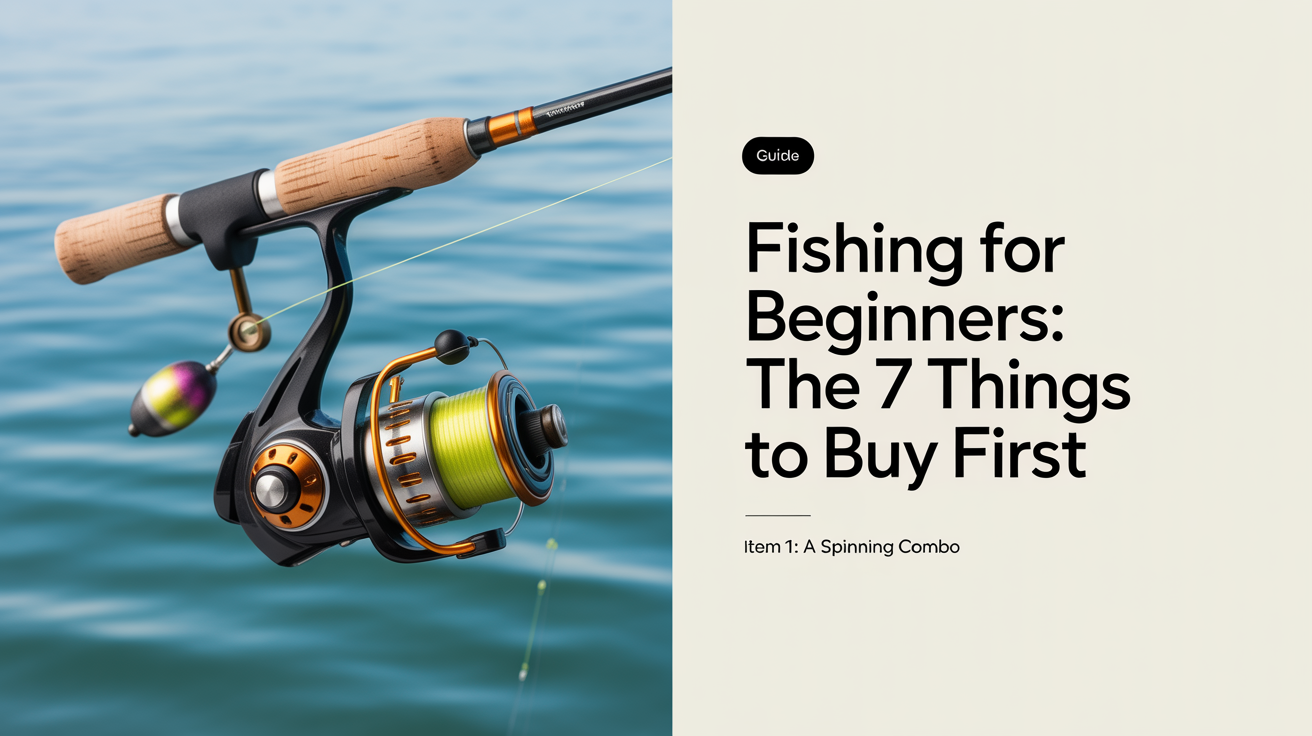
A spinning combo pairs a rod and reel on the same spool. For a beginner targeting panfish, bass, and similar freshwater species, a 6- to 7-foot medium-light or medium-power rod with a fast or moderate-fast action is the most versatile starting point. That rod length gives you enough casting leverage without being unwieldy on a small bank or dock.
Spinning reels are sized by number, a 2500 or 3000-size reel matches a 6–7 foot rod well and has enough line capacity for most freshwater situations. Look for a reel with a smooth drag (the knob or dial that lets line peel out under pressure) and a bail that clicks solidly open and closed.
Pre-matched combos sold as a single package are usually the best value for a first purchase. They're balanced to each other so you don't end up with a heavy reel on a flimsy rod.
If you want more background on what rod specs actually mean, our article on how to choose a fishing rod walks through length, power, and action in plain terms.
Item 2: Monofilament Line
Your reel probably comes pre-spooled with thin filler line, strip it off and replace it. Monofilament (mono) in the 6–10 lb test range is the right starting line for most freshwater beginners. Six-pound suits panfish and light bass work; 8–10 lb handles larger bass, catfish, and situations where you're fishing near heavy cover like docks or weeds.
Why mono over braid or fluorocarbon as a starter? It stretches slightly, which forgives hook-set mistakes; it ties standard knots reliably; and it's inexpensive enough that you can re-spool without wincing. Most beginners will learn the improved clinch knot or the Palomar knot first, both hold well in mono.
The trade-off is that mono degrades with UV exposure and repeated wetting/drying. Plan to re-spool every season or whenever you notice the line feels brittle or curls badly off the reel.
Item 3: Hooks
Hooks are the one item where variety pays off early. A small assortment of sizes 6, 4, 2, and 1/0 covers most freshwater scenarios. The size numbering is counterintuitive: size 6 is smaller than size 2, and once you cross into the "aught" system, 1/0 is larger than size 1.
For live bait like worms or minnows, a simple wire bait-holder hook (the style with two small barbs on the shank to grip soft bait) in size 6 or 4 is a starting point for bluegill and perch. Bump up to size 2 or 1/0 for bass or larger bait.
Keep them sharp. A hook that slides off your fingernail instead of catching slightly is too dull to penetrate a fish's mouth cleanly. Hooks are cheap, replace them before they get corroded or bent.
Item 4: Split-Shot Sinkers
A split-shot sinker is a small round weight with a groove you press onto the line with your thumbnail or pliers. They add enough mass to get a lightweight bait down through the water column and reach fish that aren't feeding at the surface.
For most panfish and bass fishing with a bobber rig, a size BB or size 1 split-shot placed 8–12 inches above your hook is enough. For fishing deeper or in moving water, you may need a heavier egg sinker or a small bank sinker threaded onto the line above a swivel.
The practical appeal of split-shot is flexibility, you can add one, remove one, or reposition one without cutting your line.
Item 5: Bobbers
A bobber (also called a float) serves two purposes: it keeps your bait at a set depth, and it shows you when a fish has taken interest. When the bobber dips, tips sideways, or moves against the current, something is investigating your hook.
Clip-on round bobbers are the most common starter type. They're inexpensive and easy to move up or down the line to change depth. Set the bobber so your bait hangs just above the bottom in still water, or a few feet down in deeper situations.
Slip bobbers are a modest upgrade worth considering even early on, the line runs through the center of the bobber rather than clipping onto it, which makes casting longer distances much cleaner. A small bead and a bobber stop (a little knot-stopper that costs almost nothing) keeps the float at the depth you want.
Item 6: A Few Lures
Live bait catches fish reliably, but lures let you cover water, change presentations quickly, and fish without the hassle of keeping bait alive. For a beginner's first small lure selection, three types give you solid coverage:
Inline spinners (1/8 to 1/4 oz): A spinning blade that produces flash and vibration. Easy to cast and retrieve at a steady pace. Effective on bass, trout, perch, and pike.
Soft plastic grubs or curly-tail worms (3–4 inch): Thread one onto a 1/8 oz jig head and you have one of the most versatile lures in freshwater fishing. Slow-roll it along the bottom or let it fall near structure. Works on nearly everything.
Small hard crankbaits or lipless rattlers: A cast-and-wind lure that dives a few feet on the retrieve. The built-in rattle attracts fish in stained or murky water where visibility is low.
Three lures, one spinner, one jig-head with grubs, one small crankbait, is plenty to start. For a deeper look at which lures produce consistently, see our guide on the 7 best beginner lures that catch fish almost anywhere.
Item 7: Needle-Nose Pliers and Line Clippers
These are the two tools you'll reach for at the water's edge every single session.
Needle-nose pliers do the important work of removing hooks from fish mouths without sticking your fingers near a thrashing set of teeth or a deeply swallowed hook. They also crimp split-shot onto your line and straighten bent hooks. Get a pair with a corrosion-resistant coating, fishing pliers spend a lot of time wet.
Line clippers (or nail clippers in a pinch) trim tag ends after tying knots and cut old line when re-rigging. Scissors work but are awkward in cold or wet conditions. A small pair of clippers on a retractable zinger attached to your shirt or jacket keeps them accessible without fumbling through a bag.
Putting It Together: A Simple Starter Rig
Once you have these items, the most common beginner setup is a basic bobber-and-bait rig:
- Tie your hook to the end of the main line with an improved clinch knot or Palomar knot.
- Pinch a BB split-shot onto the line about 10 inches above the hook.
- Clip or thread a bobber onto the line 18–36 inches above the hook (adjust based on water depth).
- Bait the hook with a piece of worm, a small minnow, or a soft plastic grub.
That rig is legal, effective, and simple enough to set up in under two minutes. When you're ready to learn to cast, our step-by-step casting guide for beginners covers the basic overhead cast and a few common mistakes to avoid.
FAQ
Do I need a brand-name rod and reel to start?
No. Mid-range gear from any major sporting-goods retailer will handle everything a beginner catches. The fish don't know what's on the other end of the line. Once you've been fishing for a season and know which style of fishing you enjoy most, then it makes sense to invest in higher-quality specific gear.
Can I use one rod for all types of freshwater fishing?
A medium-light spinning rod handles a wide range of freshwater species and situations. It won't be the ideal choice for every scenario, a heavy-action rod is better for big catfish, and a light-power rod suits tiny stream trout more precisely, but a single all-purpose setup is completely reasonable for a first or second season.
What's the minimum I need to spend to get fishing?
A functional spinning combo, replacement line, a basic assortment of hooks and weights, a bobber, and a pair of pliers can be assembled for $40–$60 if you shop at a discount retailer or sporting-goods chain. Adding a few lures pushes that to around $70–$80. A fishing license adds to that cost but is non-negotiable on public waters.
What about bait, should I use live bait or artificial lures?
For a first trip, live bait (worms especially) is forgiving because it produces scent, which fish can detect even when visibility is poor. Lures require more active technique and presentation knowledge. Many beginners start with worms and add lures as they get comfortable with casting and retrieval.
Do I need a tackle box right away?
Something to organize your hooks, sinkers, and lures is worth having from the start. A small plastic compartment tray with a lid keeps hooks from ending up loose in a bag (a painful mistake) and lets you see at a glance what you have. Dedicated tackle boxes with multiple trays come later, when you've accumulated enough gear to need them.
Tackle Theory is an independent freshwater-fishing resource. Our guides are researched and written in-house; we are not affiliated with, endorsed by, or sponsored by any tackle brand, retailer, or guide service. Fishing licenses, seasons, and size and creel limits vary by location, always confirm current regulations with your local fish and wildlife agency before you fish.